
Purchase Order Funding vs Bank Loan: Honest SA Guide
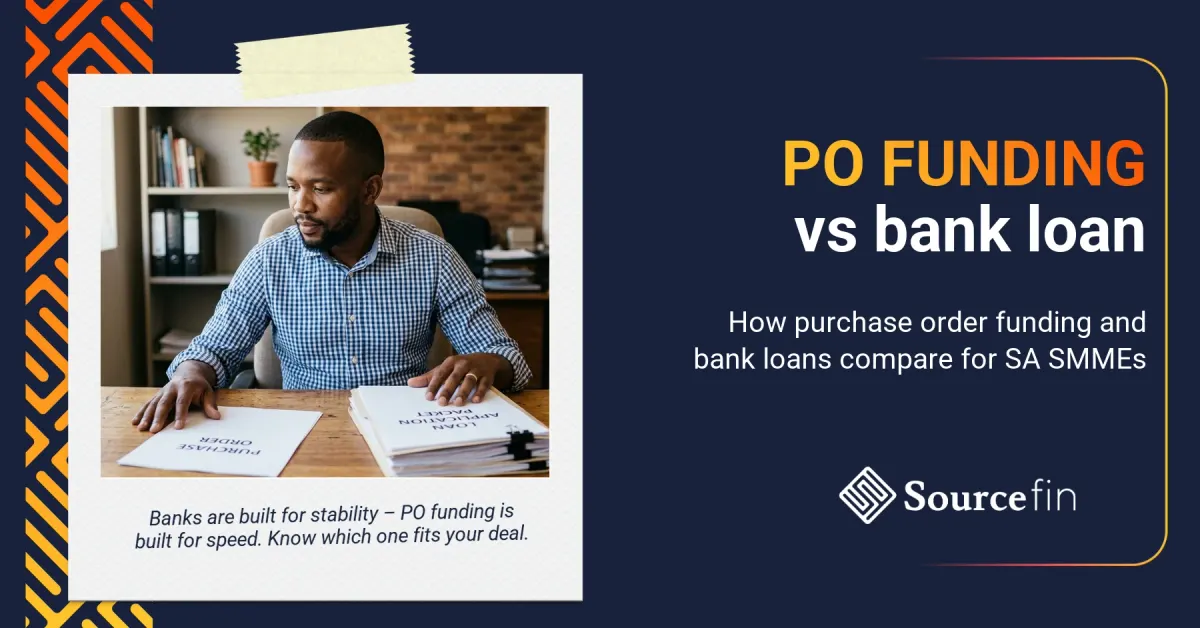
How does purchase order funding compare to a bank loan for South African SMMEs? Here is how they differ on speed, collateral, repayment, and fit.
On this page
- Key Takeaways
- How Purchase Order Funding Works
- How a Bank Loan Works
- Purchase Order Funding vs Bank Loan: Side-by-Side Comparison
- When a Bank Loan Is the Right Choice
- When Purchase Order Funding Is the Right Choice
- The Structural Difference: Purpose, Not Quality
- What Sourcefin Offers for SA SMMEs
- Frequently asked questions
Purchase order funding and bank loans are both financing tools, but they are built for different purposes, different risk profiles, and different stages of a business. For South African SMMEs with a confirmed purchase order or government tender but limited trading history, purchase order funding is designed to fund the opportunity in front of you – not the balance sheet behind you. Understanding the difference shapes which one you should apply for.
Key Takeaways
- Purchase order funding is repaid from the deal itself – not on a fixed monthly schedule like a bank loan.
- Bank loans require credit history, trading track record, and often collateral. Purchase order funding assesses the deal and the client's character.
- Banks are built for stability and conservative risk mandates. Purchase order funding is built for speed and deal-specific risk.
- For SMMEs with confirmed orders but limited trading history, purchase order funding is almost always the correct product.
- Sourcefin has deployed R2.8 billion to over 2,000 South African SMMEs – funding deals banks structurally cannot approve.
Purchase order funding is deal-specific short-term finance: the funder pays your supplier, you deliver to your customer, your customer pays, and the funder is repaid from those proceeds. A bank loan is general working capital repaid on a fixed monthly schedule regardless of individual deal performance. The core difference is purpose – purchase order funding is built around one confirmed order, while a bank loan serves a business's broader ongoing working capital needs.
How Purchase Order Funding Works
Purchase order funding provides capital to cover the cost of fulfilling a confirmed order. When your customer – a government department, a corporate buyer, or a large retailer – places an order with you that you do not have the upfront capital to fulfil, a purchase order funder steps in.
The funder pays your supplier directly. You receive the goods, you deliver to the customer, the customer pays you, and the funder receives the advance plus an agreed profit share. The full cycle is deal-specific: you only owe what the deal generated, and repayment comes from the deal's proceeds – not from your general cash flow.
For South African SMMEs, this model works particularly well for government tenders and large corporate purchase orders, where payment terms of 30–90 days create a gap between when you need to fund delivery and when the money arrives.
How a Bank Loan Works
A bank loan provides a lump-sum advance that is repaid over a fixed term – monthly instalments, predetermined interest rates, structured repayment schedules. The bank assesses your application based on your credit history, your financial statements (often two to three years of audited accounts), your business's cash flow track record, and the security you can offer against the loan.
Once approved, the funds are yours to use as needed. The repayment obligation begins immediately and continues regardless of how any individual business deal performs. A bank loan is working capital – flexible but tied to your business's overall financial health, not the outcome of a specific contract.
Purchase Order Funding vs Bank Loan: Side-by-Side Comparison
| Criteria | Purchase Order Funding | Bank Loan |
|---|---|---|
| What it funds | A specific confirmed order | General business needs |
| Approval criteria | Quality of the deal, client trust, end-buyer ability to pay | Credit history, audited financials, collateral, trading history |
| Collateral required | No (with the right funder) | Usually yes |
| Repayment structure | Repaid from the deal's proceeds when the customer pays | Fixed monthly instalments over a set term |
| Approval timeline | 48-hours (term sheet) with strong funders | Weeks to months |
| Minimum trading history | Not required – deal is assessed on its own merits | Typically 2–3 years required |
| End-to-end support | Best funders offer sourcing, logistics, delivery oversight | Capital only |
| Who it suits best | SMMEs with confirmed orders, tenders, or POs to fulfil | Established businesses needing general working capital |

When a Bank Loan Is the Right Choice
Bank loans are the right product when your business needs general working capital that is not tied to a specific order. If you need to buy equipment, renovate premises, hire staff, or manage ongoing cash flow across multiple contracts, a bank loan's flexibility can be the better fit.
Banks are designed for stability. They provide long-term credit relationships, treasury products, and a financial infrastructure that growing businesses eventually need. Their conservative approval criteria are not a failing – they reflect a mandate to protect depositors and maintain systemic financial health. A well-established SMME with two or three years of clean financial statements, stable cash flow, and an existing banking relationship is well-positioned to access bank financing at competitive rates.
The challenge is that most South African SMMEs seeking purchase order funding do not yet fit that profile. That is not their fault – it is simply where they are in the business cycle.
When Purchase Order Funding Is the Right Choice
Purchase order funding is the right product when you have a specific, confirmed order and need capital to fulfil it – but do not have the trading history, collateral, or time to access traditional bank financing.
It is particularly well-suited to:
- Government tender winners who need to pay suppliers before the department pays them.
- Emerging SMMEs with their first or second large contract, where the opportunity exceeds their current cash reserves.
- Growing businesses that have won more orders than their current working capital can service simultaneously.
- Any business where the order requires supplier payment before customer payment – which describes almost every product supply deal in the market.
The structural logic is straightforward: if you have the order, the risk is in the delivery – not in your credit history. Purchase order funding is designed around that logic.
The Structural Difference: Purpose, Not Quality
It is tempting to frame this as purchase order funding being "better" than a bank loan for SMMEs. That is not the right way to think about it. Banks and purchase order funders serve different purposes, assessed against different risk frameworks, for different stages of business growth.
Banks are built for stability. Purchase order funders are built for speed. Neither is trying to replace the other. The more useful question is not which one is better – it is which one is right for what you need right now.
For a South African SMME with a confirmed government tender and no three-year trading history, the answer is usually clear: purchase order funding. For an established business with clean financials looking to fund equipment or general expansion, a bank may be the right first call.
Many of Sourcefin's longest-standing clients have bank relationships as well. The two products work alongside each other in a well-structured SMME financial stack.
What Sourcefin Offers for SA SMMEs
For South African SMMEs who fit the purchase order funding profile, Sourcefin provides purchase order funding without collateral requirements, with a term sheet inside 48 hours approval, and with end-to-end delivery support including access to a 2,000-supplier pre-vetted network.
Sourcefin has deployed R2.8 billion to over 2,000 South African SMMEs – a verified track record of funding the deals that banks structurally cannot approve. The deals are not risky in the way banks define risk. They are deals where the order is confirmed and the opportunity is real, but the client does not yet have the history or assets a bank's mandate requires.
"Built for speed where banks are built for stability. If you have the order, Sourcefin has the capital."
If you have won a tender or hold a confirmed purchase order and need to fund the delivery, apply directly via Sourcefin's funding application. For those still looking for opportunities, TenderCentral lists open government tenders across South Africa at no cost.
For comparison between Sourcefin's two core products, read the full guide to PO funding versus invoice discounting for SA SMMEs.
Sources & References
South African Reserve Bank. Bank Supervision Annual Report. 2025. resbank.co.za
Frequently asked questions
What is the difference between purchase order funding and a bank loan?
Purchase order funding is tied to a specific confirmed order and repaid from that deal's proceeds when the customer pays. A bank loan is a general working capital advance repaid on a fixed monthly schedule regardless of how any individual deal performs. Purchase order funding does not require trading history or collateral. Bank loans typically require both.
Is purchase order funding better than a bank loan for South African SMMEs?
Neither is better – they serve different purposes. Purchase order funding is built for SMMEs with confirmed orders but limited trading history or collateral. Bank loans suit established businesses needing general working capital across multiple contracts. Many growing SMMEs use both: purchase order funding to fulfil specific deals, and bank credit for general operational needs as the business matures.
Does purchase order funding require collateral the way a bank loan does?
The best purchase order funders do not require collateral. They assess the quality of the confirmed order, the client's ability to deliver, and the end buyer's creditworthiness. Bank loans almost always require security – property, equipment, or other fixed assets. For emerging SMMEs with no asset base, purchase order funding is typically the only viable path to funding a specific deal.
How fast is purchase order funding approval compared to a bank loan?
Purchase order funding is significantly faster. Strong funders issue term sheets in as little as 48 hours of a complete application, with full deal funding completing within 5–10 business days. Bank loan approvals typically take weeks to months due to credit assessments, financial statement reviews, and collateral valuations – a timeline that does not suit most tender or purchase order delivery deadlines.
Can a South African SMME with no trading history get purchase order funding?
Yes. Purchase order funding does not require a trading history. The funder assesses the specific deal: the confirmed order, the client's ability to deliver, and the end buyer's creditworthiness. A new SMME with their first government tender or corporate purchase order can access purchase order funding on the merits of that deal alone.
Do I need to choose between purchase order funding and a bank loan?
No. Many established South African SMMEs use both: purchase order funding for deal-specific capital when they win tenders or large orders, and bank credit for general working capital needs. The two products address different parts of a business's financial structure and work alongside each other as the business grows and its banking relationship develops.

Sourcefin is a South African alternative finance provider that offers purchase order funding and invoice discounting to SMMEs, enabling businesses to fulfil confirmed purchase orders or tenders and unlock cash flow without collateral. Unlike traditional lenders or banks, Sourcefin also provides end-to-end support including supplier sourcing, logistics, project management, and risk oversight.